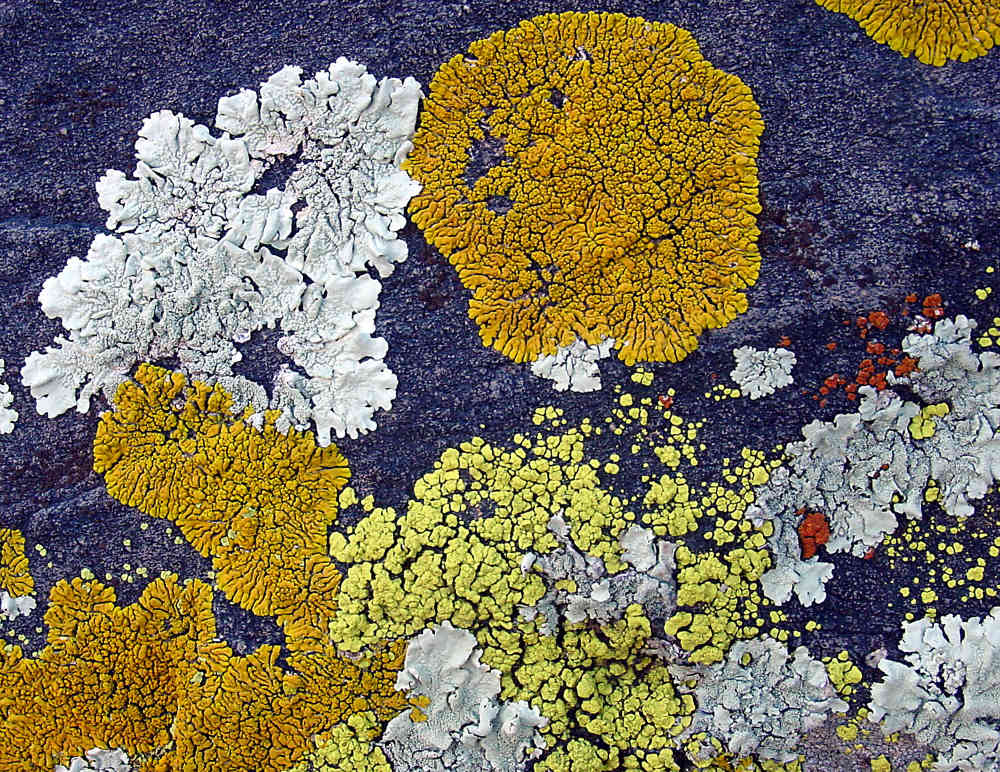
That crusty patch of plant-like material growing on a rock behind your house is called a
lichen. But it is also so much more. Lichens are composite organisms formed by the association of a fungus (the
mycobiont) and an alga and/or cyanobacterium (the
photobiont). Together, they form an organism with physiological properties quite unlike that of either of the equivalent free-living constituents. For one, lichens are surprisingly tolerant to a range of environmental parameters, allowing them to live in some of the most extreme conditions on the planet. And yet, they serve as “canaries in a coal mine” when it comes to pollution, due to their sensitivity to many environmental contaminants. The unique symbiotic relationship exhibited in lichens reveals itself in a variety of shapes and sizes, including hair-like (filamentous), crust-like (crustose), leaf-like (foliose), and powder-like (leprose), among others. The photobiont provides sugars produced by the reduction of carbon dioxide using sunlight, while the mycobiont provides nutrients and a hydrous environment for the bacteria or algae. Apart, many of the companion organisms cannot survive. Food for thought: How does one classify a symbiotic organism made up of a fungus and an alga and/or bacterium?