Showing posts with label Other Eukarya. Show all posts

Saturday, February 26, 2011

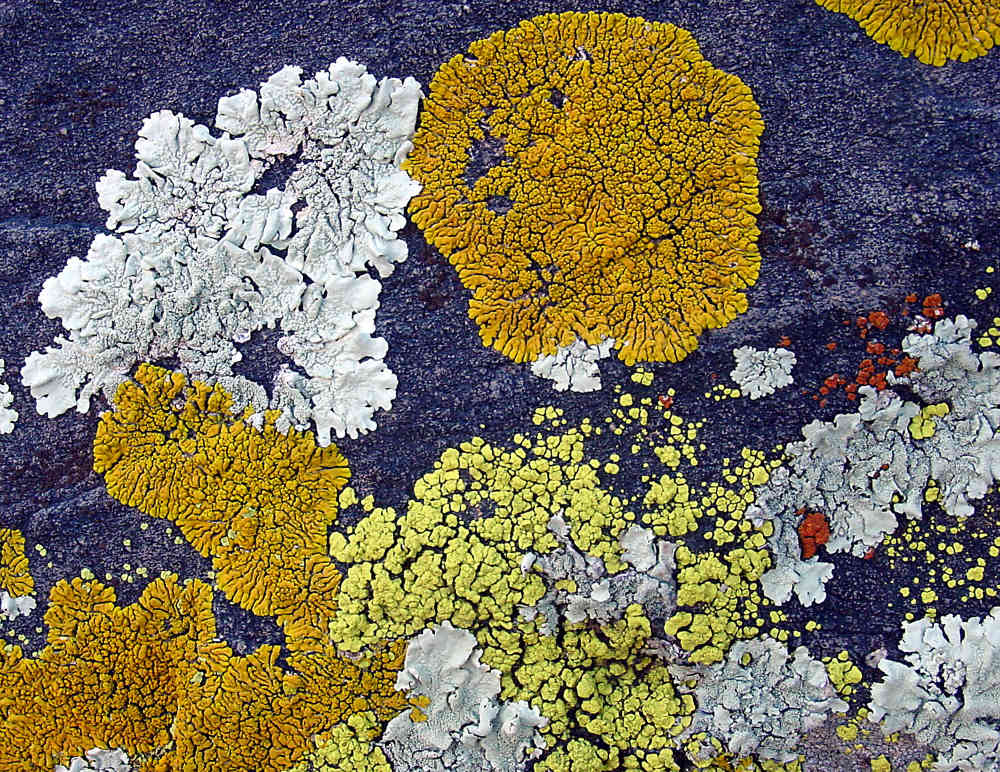
I'm Taking a Lichen to This.

A colorful array of cructose lichens (Photo credit: Arizona-Sonora Desert Museum)
That crusty patch of plant-like material growing on a rock behind your house is called a lichen. But it is also so much more. Lichens are composite organisms formed by the association of a fungus (the mycobiont) and an alga and/or cyanobacterium (the photobiont). Together, they form an organism with physiological properties quite unlike that of either of the equivalent free-living constituents. For one, lichens are surprisingly tolerant to a range of environmental parameters, allowing them to live in some of the most extreme conditions on the planet. And yet, they serve as “canaries in a coal mine” when it comes to pollution, due to their sensitivity to many environmental contaminants. The unique symbiotic relationship exhibited in lichens reveals itself in a variety of shapes and sizes, including hair-like (filamentous), crust-like (crustose), leaf-like (foliose), and powder-like (leprose), among others. The photobiont provides sugars produced by the reduction of carbon dioxide using sunlight, while the mycobiont provides nutrients and a hydrous environment for the bacteria or algae. Apart, many of the companion organisms cannot survive. Food for thought: How does one classify a symbiotic organism made up of a fungus and an alga and/or bacterium?

Saturday, January 22, 2011

Bioluminescent Mushrooms

Bioluminescent mushrooms (Photo credit: Cornell University)
Imagine hiking through the woods at night, turning off your headlamp, and finding the forest floor aglow with bioluminescent mushrooms. A couple months ago, while hiking to the Mount Hypipamee Crater in Queensland, Australia, I had the pleasure of seeing, not just imagining, this uncanny phenomenon. Very little is known about how, or why, certain fungi glow in the dark - only that they do, and that over 70 species have been found to exhibit this trick of nature. The eerie green light emitted by the mushrooms and surrounding leaf and bark litter interwoven with mycelia, comes as the result of a reaction between oxygen, the protein luciferin, the catalyst luciferase (both from Lucifer, "light bearer"), and occasionally other cofactors. Other organisms exhibit this feature, including bacteria, fireflies, the Cookiecutter shark, anglerfish, and many others. But why mushrooms? To attract insects for spore dispersal? To warn of toxicity? A byproduct of lignin degradation? No one knows for sure.

Reference: Cornell University Mushroom Blog