Showing posts with label Invertebrate Zoology. Show all posts

Wednesday, March 23, 2011

The Namib Desert Beetle: A Recipe for Water

The Namib Desert Beetle laden with water droplets (Photo credit: Solvin Zankl)
As the early morning fog drifts across the Namib Desert of south-west Africa, an army of spindly-legged beetles emerges from the sand. Accustomed to an average annual rainfall of one inch, these critters are eager to employ their water collection apparatus that makes them so unique. The process begins when heat is radiated from the matte black exoskeleton, resulting in a body temperature slightly lower than that of the surrounding air. With the beetle's body held at a 45° angle to the sand, the moist breeze contacts the cool exoskeleton and water condenses into small droplets. This beading effect is facilitated by a series of hydrophilic (water attracting) bumps surrounding by a waxy, hydrophobic (water repelling) surface on the insect's back. The droplets may grow to nearly a quarter of an inch, and then roll down to be gratefully sequestered by the beetle's mouthparts. And then it's back down the dunes and away from the morning sun for these diminutive hydroplants.

A seawater greenhouse in Australia (Read about the exciting initiative here)
Researchers at MIT have used this peculiar water collection mechanism as a model for the synthesis of materials used in a range of innovative research and industrial devices (See the news article here). Among other applications of this mechanism is a seawater greenhouse project designed for arid coastal regions, described by Michael Pawlyn in his presentation entitled "Using nature's genius in architecture" (Available on TED here). These projects represent yet another example of innovation based directly on natural systems observed on this planet - the ultimate design project.

Can't get enough?
The beetle's water collection mechanism was first described in the article: Parker, Andrew R., and Lawrence, Chris R. November, 2010 "Water capture by a desert beetle." Nature 414: 33-34. More about this insect, and other biomimicry projects can be explored on AskNature. Watch the BBC wildlife feature on this beetle here.

Saturday, January 29, 2011

Aphids and Telescoping Generations

Aphid adult and nymphs (Photo credit: humbleseed.com)
If you could imagine an organism that gives birth to offspring that are already pregnant with a third generation, it would look something like a small, green, herbaceous insect. We call them aphids. As one of the world's worst agricultural pests, species of this group of insects exhibit a variety of peculiar reproductive strategies, including this phenomenon of telescoping generations. In many species, all of the overwintered eggs that hatch in the spring result in females, which then reproduce asexually to render generation after generation of genetically-identical female aphids (cyclical parthenogenesis). When autumn arrives, the females give live birth to both male and female offspring, lacking wings and often mouthparts. And upon sexual reproduction of these progeny, the females, rather than giving live birth (vivipary), lay eggs (ovipary) which overwinter and renew the cycle.

Because of the agricultural significance of this insect, scientists have sequenced the genome of one particular species, the Pea Aphid. Read the journal article here.

Friday, January 21, 2011

Green Ants: Engineering with Living Glue-sticks

Nest-building teamwork (Photo credit: Wikipedia)
During my recent stay in Australia, I became acquainted with "green ants." Belonging to the family Formicidae, these minute laborers produce formic acid in their gaster (posterior abdominal region), making them unpalatable to many would-be predators. Any decent Aussie will take the time to demonstrate how this chemical feature allows you to lick the ant's posterior and receive a sharp bitter sensation lasting up to several minutes. Next time you're in northern Australia, don't pass up the opportunity! Strictly eusocial in nature, a colony of green ants will work together to construct an arboreal nest, or series of nests, by binding together living leaves found nearby on the branch. To achieve this feat, the ants grasp on to each others' waists to form a chain between adjacent leaves; shortening the chain by one link at a time brings the two leaves in close proximity. At the same time, other workers will retrieve their silk-producing larvae from the interior of the nest, and hold them in such a way as to smear silk along the seam between two leaves, binding them together. Imagine that! Using your kids as glue-sticks to engineer your home.

Read more on green ants.

Portuguese Man o' War: An Assisted Living Community

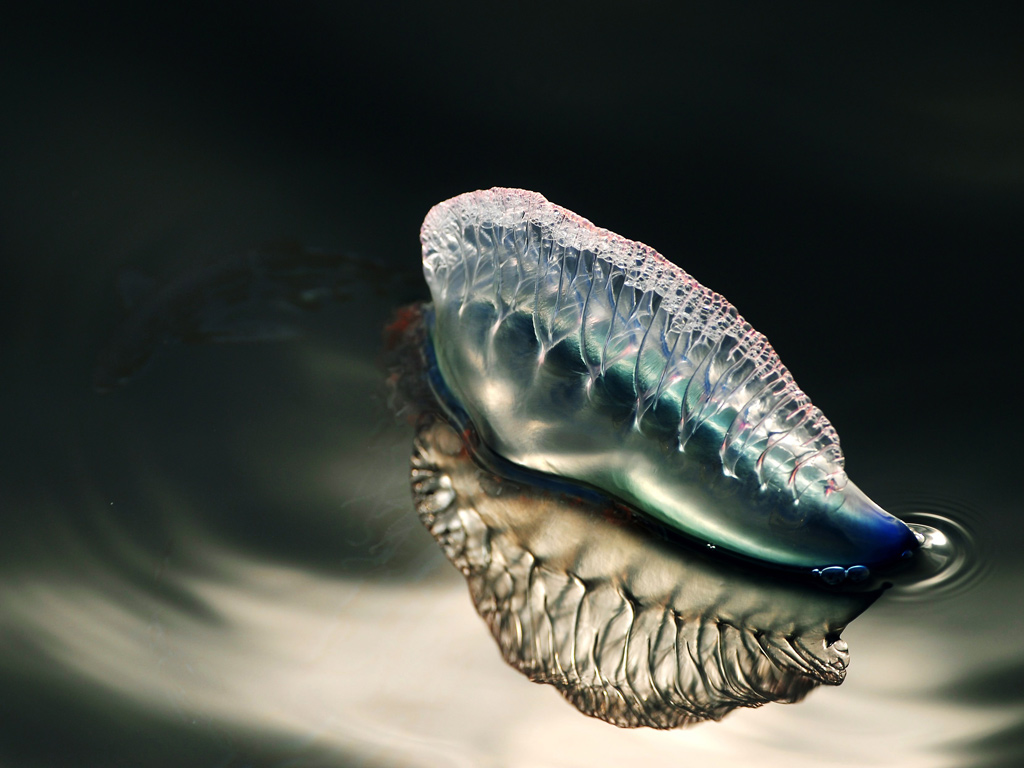
Portuguese Man o' War (photo credit: www.guardian.co.uk)
Did you know that the Portuguese Man o' War is not a true jellyfish, but a colony of many, many microscopic organisms called zooids? Together, their association results in a majestic, and potentially deadly marine organism called a siphonophore; apart, they cannot survive. The downward-hanging tentacles, averaging 30 feet in length, employ millions of stinging organelles, called nematocysts, to catch and kill its prey within seconds. A distinct group of zooids is then responsible for digestion of prey items, while another forms the gas-filled "sail" which controls the organism's position at or below the ocean's surface.

Read more on the Portuguese Man o' War.