Saturday, January 29, 2011

Aphids and Telescoping Generations

Aphid adult and nymphs (Photo credit: humbleseed.com)
If you could imagine an organism that gives birth to offspring that are already pregnant with a third generation, it would look something like a small, green, herbaceous insect. We call them aphids. As one of the world's worst agricultural pests, species of this group of insects exhibit a variety of peculiar reproductive strategies, including this phenomenon of telescoping generations. In many species, all of the overwintered eggs that hatch in the spring result in females, which then reproduce asexually to render generation after generation of genetically-identical female aphids (cyclical parthenogenesis). When autumn arrives, the females give live birth to both male and female offspring, lacking wings and often mouthparts. And upon sexual reproduction of these progeny, the females, rather than giving live birth (vivipary), lay eggs (ovipary) which overwinter and renew the cycle.

Because of the agricultural significance of this insect, scientists have sequenced the genome of one particular species, the Pea Aphid. Read the journal article here.

Saturday, January 22, 2011

Bioluminescent Mushrooms

Bioluminescent mushrooms (Photo credit: Cornell University)
Imagine hiking through the woods at night, turning off your headlamp, and finding the forest floor aglow with bioluminescent mushrooms. A couple months ago, while hiking to the Mount Hypipamee Crater in Queensland, Australia, I had the pleasure of seeing, not just imagining, this uncanny phenomenon. Very little is known about how, or why, certain fungi glow in the dark - only that they do, and that over 70 species have been found to exhibit this trick of nature. The eerie green light emitted by the mushrooms and surrounding leaf and bark litter interwoven with mycelia, comes as the result of a reaction between oxygen, the protein luciferin, the catalyst luciferase (both from Lucifer, "light bearer"), and occasionally other cofactors. Other organisms exhibit this feature, including bacteria, fireflies, the Cookiecutter shark, anglerfish, and many others. But why mushrooms? To attract insects for spore dispersal? To warn of toxicity? A byproduct of lignin degradation? No one knows for sure.

Reference: Cornell University Mushroom Blog

Friday, January 21, 2011

The Alpine Salamander: Try Beating this Record

The Alpine Salamander (Photo credit: Herpetofauna of Europe)
As the name suggests, this small black salamander lives high in the Alps of central Europe. Living an average of 10 years and measuring 12 centimeters in length, the female typically gives birth to two young after a gestation period of up to three years, depending on its elevation. This is the longest known gestation period of any animal. As you might expect, the young are well developed and quite large, almost half the length of the adult. In the initial stages of embryonic development, one embryo in each uterus is nourished by its own yolk and the yolks of its not-so-fortunate siblings. Once this resource is depleted, the young eat the vitelline mass available in the uterus. And finally, their external gills are used to acquire nutrients from the maternal fluids. Surprisingly, with such a long pregnancy and small number of offspring, these peculiar amphibians are quite common in their current distribution.

Reference: A Compendium of Indispensable Facts (Ben Horslen, 2004)

Green Ants: Engineering with Living Glue-sticks

Nest-building teamwork (Photo credit: Wikipedia)
During my recent stay in Australia, I became acquainted with "green ants." Belonging to the family Formicidae, these minute laborers produce formic acid in their gaster (posterior abdominal region), making them unpalatable to many would-be predators. Any decent Aussie will take the time to demonstrate how this chemical feature allows you to lick the ant's posterior and receive a sharp bitter sensation lasting up to several minutes. Next time you're in northern Australia, don't pass up the opportunity! Strictly eusocial in nature, a colony of green ants will work together to construct an arboreal nest, or series of nests, by binding together living leaves found nearby on the branch. To achieve this feat, the ants grasp on to each others' waists to form a chain between adjacent leaves; shortening the chain by one link at a time brings the two leaves in close proximity. At the same time, other workers will retrieve their silk-producing larvae from the interior of the nest, and hold them in such a way as to smear silk along the seam between two leaves, binding them together. Imagine that! Using your kids as glue-sticks to engineer your home.

Read more on green ants.

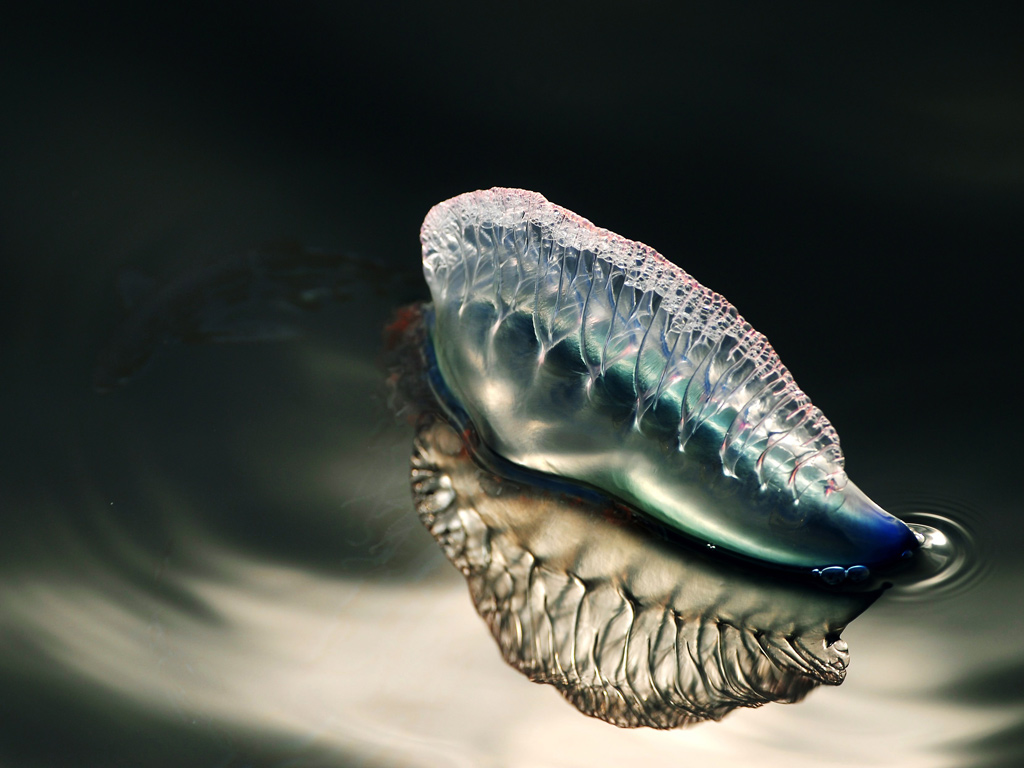
Portuguese Man o' War: An Assisted Living Community

Portuguese Man o' War (photo credit: www.guardian.co.uk)
Did you know that the Portuguese Man o' War is not a true jellyfish, but a colony of many, many microscopic organisms called zooids? Together, their association results in a majestic, and potentially deadly marine organism called a siphonophore; apart, they cannot survive. The downward-hanging tentacles, averaging 30 feet in length, employ millions of stinging organelles, called nematocysts, to catch and kill its prey within seconds. A distinct group of zooids is then responsible for digestion of prey items, while another forms the gas-filled "sail" which controls the organism's position at or below the ocean's surface.

Read more on the Portuguese Man o' War.

Now Hiring (Re)Naturalists - No Experience Required

Photo taken in Cairns, Australia.
Welcome. You, my friend, are witnessing the birth of the "(Re)Naturalist" - a portal for everyday naturalists to share in the discovery, rediscovery, and self-discovery of nature. To take advantage of the jaw-dropping facts, eye-popping photographs, and mind-boggling ideas to come soon, follow this blog using the link at right, and share your favorite posts using the facebook/twitter/etc. links below each entry. If your inner naturalist would like to contribute to the conversation - comment, contact me with topics or links, or provide constructive feedback!